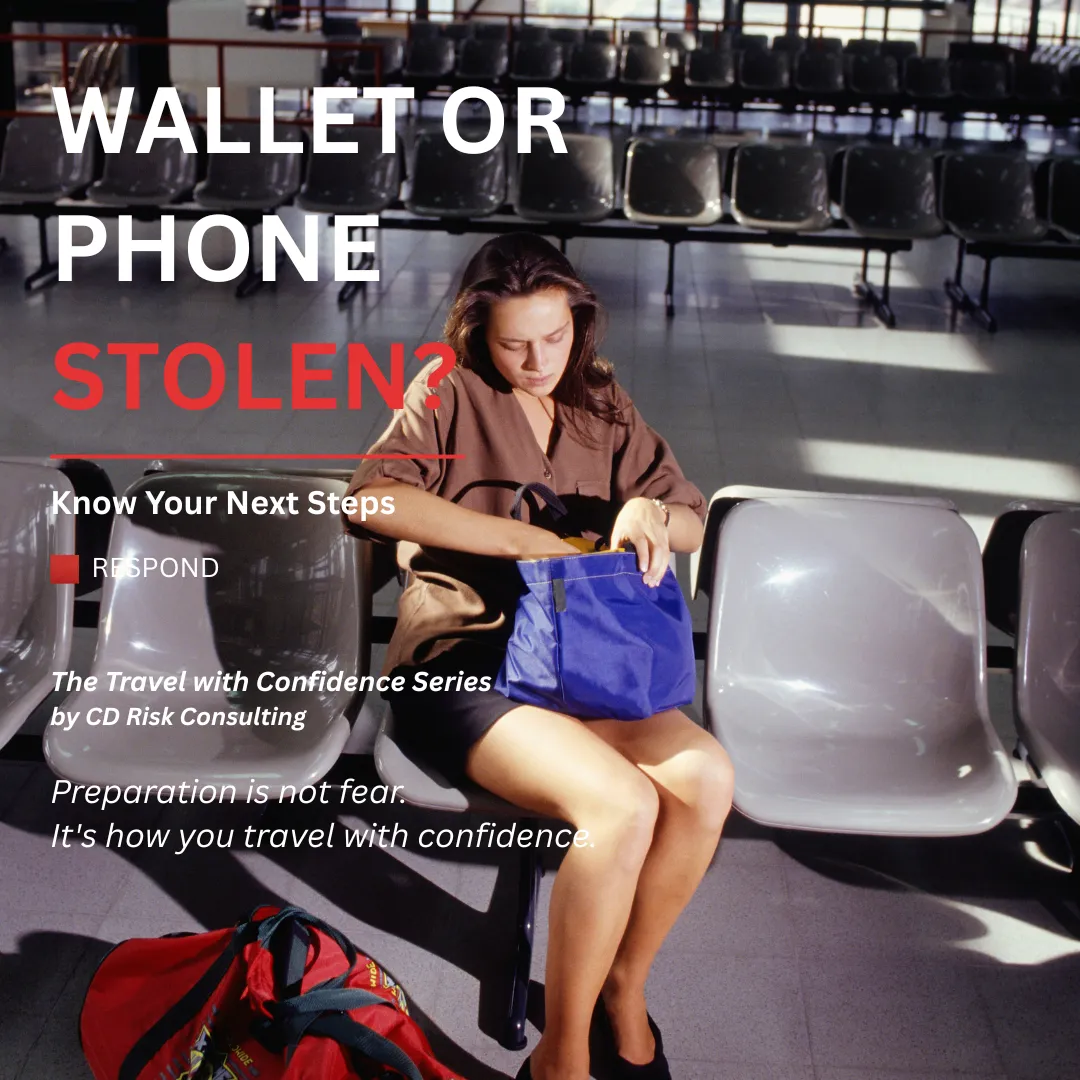
Wallet or Phone Stolen While Traveling? 7 Steps to Take
Seven practical steps to protect your information, regain access to essential resources, and get your trip back on track.
Imagine you're exploring a new city.
You've spent the morning sightseeing, stopped for lunch, and are getting ready to head back to your hotel.
You reach for your phone.
It's gone.
Or perhaps you open your bag to pay for something and discover your wallet is missing.
For a moment, you're trying to figure out what happened.
Did you leave it somewhere? Did it fall out of your bag? Or was it stolen?
Now you're thinking about your credit cards, identification, banking applications, hotel reservations, and transportation arrangements.
If you're traveling internationally, you may also be wondering how you'll access money or communicate with someone back home.
Losing a wallet or phone can create more than an inconvenience. It can affect several parts of your trip at once.
But here's what I want you to remember:
Losing access to something important doesn't mean you've lost control of the situation.
Throughout my career in executive protection and international travel security, preparation and contingency planning have been central to managing unexpected situations.
One of the principles I emphasize is that an effective response begins with understanding your priorities.
When something goes wrong, you don't need to solve every problem at once.
You need to identify what matters most and work through the next steps.
Let's look at seven practical actions to take if your wallet or phone goes missing while traveling.
1. Prioritize Your Personal Safety
Before you start searching for your belongings, consider your surroundings.
If you believe someone stole your wallet or phone, avoid confronting or chasing a suspected thief.
Recovering property is never worth placing yourself in danger.
If you're in a crowded market, transportation station, or unfamiliar neighborhood, move to a safer location where you can assess what happened.
A hotel lobby, staffed business, transportation information desk, or another appropriate public location may provide a place to regroup.
If you've been threatened, assaulted, or injured, contact local emergency services.
Once you're safe, take a moment to establish what is actually missing.
Was it your wallet, phone, or both?
Do you still have your passport?
Do you have access to another payment method?
Can you contact someone for assistance?
These questions help you identify your immediate priorities.
Your safety comes first. Everything else can be addressed afterward.
2. Confirm What's Missing and Retrace Your Steps
Before assuming your belongings were stolen, make a reasonable effort to determine whether they were misplaced.
Check your pockets, bag compartments, and any other locations where you normally keep your belongings.
Think about the last time you used the missing item.
Did you pay for something at a restaurant?
Use your phone in a rideshare?
Leave your wallet at a hotel reception desk?
If you were recently at a restaurant, store, or transportation service, contact the business to ask whether the item was turned in.
For a missing phone, use its location service if you can access another trusted device.
However, don't attempt to recover a phone yourself from an unfamiliar or potentially unsafe location, even if its location appears on a map.
A location estimate doesn't establish who has the device or whether approaching that location would be safe.
If you believe the item was stolen, move promptly to protecting your accounts and information.
The goal is to confirm the loss without delaying important protective actions.
3. Protect Your Phone and Personal Information
For many travelers, a smartphone is much more than a communication device.
It may contain access to:
Banking and payment applications.
Email accounts.
Travel reservations and boarding passes.
Personal photographs and documents.
Password managers and authentication applications.
Emergency contact information.
That's why a stolen phone can create significant problems beyond the cost of replacing the device.
If you have an iPhone
Use Apple's Find My service from another trusted device or visit iCloud.com/find.
If you cannot locate the phone, mark it as lost as soon as possible.
Lost Mode helps secure the device and can suspend eligible payment cards associated with Apple Pay.
Depending on the circumstances, you may also need to erase the device remotely.
If you have an Android phone
Use Google's Find Hub service at android.com/find.
Depending on the device and its settings, you may be able to locate it, mark it as lost, or erase its data.
These services generally work best when they're configured before the device disappears.
If you believe someone may have gained access to your unlocked phone, prioritize securing your email, financial, and other sensitive accounts.
Contact your mobile carrier to report the theft and discuss suspending service, protecting your phone number, and obtaining a replacement SIM or eSIM.
Be cautious about messages claiming someone found your phone. Criminals may send fraudulent links or requests for account credentials in an attempt to bypass device protections.
Mike's Travel Tip: Don't remove a missing device from your Apple or Google account simply because someone contacts you claiming they can return it. Verify any instructions through the manufacturer's official support channels.
Also, remember that remote erasure may be irreversible and can affect your ability to continue locating the device.
Protecting the information on your phone is often more important than recovering the phone itself.
4. Secure Your Credit Cards and Financial Accounts
If your wallet is missing, one of your next priorities should be contacting your financial institutions.
Report any missing credit or debit cards promptly.
Many banks allow you to temporarily lock a card through their mobile application or website.
If you believe a card was stolen, follow the bank's instructions for reporting it and obtaining a replacement.
Review recent transactions and report anything you don't recognize.
Ask your financial institution about options for accessing money while traveling.
Depending on the bank, destination, and circumstances, those options may include an emergency replacement card, emergency cash services, or another approved arrangement.
If your phone and wallet are both missing, you may need to contact your bank through its official website or a verified customer-service number using a borrowed phone or computer.
Avoid using links sent in unsolicited messages.
And don't assume that having a digital wallet means you'll always have access to money. If your phone disappears, you may temporarily lose access to the payment methods stored on it.
This is why I recommend traveling with a backup payment method stored separately from your primary wallet.
You don't necessarily need to carry a large amount of cash.
You need a reasonable way to continue paying for essential expenses if one payment method becomes unavailable.
5. Report the Theft and Protect Your Identification
If you believe your belongings were stolen, contact the appropriate local authorities.
Depending on your destination and circumstances, that may mean visiting a police station or contacting local police through a non-emergency number.
Provide a clear description of what happened, including:
Where and when you last had the item.
What you believe was taken.
Any identifying information about the missing property.
Relevant circumstances or witnesses.
Ask for a report number or a copy of the police report, if available.
This documentation may be useful for insurance claims, financial institutions, or replacement procedures.
What if your identification was in the wallet?
If your driver's license or another identification document was stolen, check the issuing agency's replacement procedures.
If your passport was also taken, the situation requires additional action.
For U.S. citizens traveling abroad, report a lost or stolen passport to the U.S. Department of State and contact the nearest U.S. embassy or consulate about replacement options.
A reported U.S. passport becomes invalid for travel, even if it's later recovered.
I've covered that process in greater detail in my Guide, Lost Your Passport Abroad? What to Do and How to Get Home.
If sensitive identification information has been exposed, consider whether additional identity-theft protections, such as a credit freeze or fraud alert, are appropriate.
Document what happened, but don't let the reporting process delay urgent financial or device-security actions.
6. Reestablish Communication and Access to Your Travel Plans
One challenge travelers sometimes overlook is how much information they rely on their phones to access.
Think about the last trip you took.
Where were your airline reservations?
Your hotel confirmation?
Your maps?
Your emergency contacts?
For many people, the answer is the same: their phone.
If that phone disappears, even routine tasks can become difficult.
You may need to contact your hotel, airline, or travel provider to retrieve reservations and confirm your arrangements.
If you're traveling alone, notify a trusted contact that your phone or wallet is missing and explain how they can reach you temporarily.
If you need to use a borrowed device or public computer, be careful about signing into sensitive accounts.
Avoid saving passwords, sign out when finished, and use a trusted device whenever possible.
If your accounts use multifactor authentication through the missing phone, you may need recovery codes, another trusted device, or your provider's account recovery process.
That's something worth preparing for before departure.
If you're unable to access funds, contact your financial institution and consider asking a trusted person at home to help you explore legitimate emergency financial arrangements.
For U.S. citizens abroad who are facing a serious financial emergency, a U.S. embassy or consulate may be able to provide information about available assistance.
The objective is to restore your ability to communicate, pay for essential needs, and access your travel arrangements.
You may not recover every lost item immediately.
But you can begin rebuilding the resources you need to continue safely.
7. Review Your Travel Plans and Decide What Happens Next
Once you've addressed immediate safety, financial, and information-security concerns, evaluate how the loss affects the rest of your trip.
Ask yourself:
Do I still have the identification required for my next flight?
Can I access my hotel reservation?
Do I have a reliable payment method?
Can I communicate with family or emergency contacts?
Will I need additional time to obtain replacement documents?
Depending on the answers, you may be able to continue your trip with only minor adjustments.
In other circumstances, you may need to change transportation arrangements, extend your hotel stay, or obtain assistance replacing important documents.
Contact your travel insurance provider if you have coverage that may apply to theft, lost belongings, or related travel disruptions.
Review the policy requirements before submitting a claim.
Keep receipts, incident reports, correspondence, and records of expenses resulting from the loss.
If your passport or other essential travel documents are missing, confirm replacement and travel requirements before making new reservations.
Don't rush into changing your entire itinerary before understanding which parts of your trip are actually affected.
Sometimes the best response is to make a few adjustments and continue.
Other times, returning home or postponing part of the trip may be the safer and more practical choice.
Mike's Travel Tip: Build Redundancy Into Your Travel Plan
One of the concepts I frequently emphasize in travel security is the importance of having a backup.
We often refer to this as redundancy.
It means not depending entirely on one item, one device, or one method of accessing something essential.
Consider how many travelers carry their phone, credit cards, identification, and emergency information together.
If that one bag disappears, several important resources may disappear with it.
Instead, think about separating critical resources.
For example:
Keep a backup payment method somewhere secure and separate from your primary wallet.
Store copies of important travel documents securely.
Maintain an offline record of emergency contacts and essential reservation information.
Configure phone-location and remote-locking features before departure.
Keep account recovery methods available if your primary phone is lost.
Share your itinerary with someone you trust.
You don't need to duplicate everything you carry.
You simply need to avoid creating a situation where losing one item means losing access to everything.
A good backup plan gives you options when your original plan stops working.
Before Your Next Trip: A Quick Wallet and Phone Security Check
Take a few minutes to answer these seven questions:
Is my phone protected? Do I have a strong passcode, automatic locking, and device-location features enabled?
Can I secure my phone remotely? Do I know how to access Find My or Find Hub from another device?
Do I have a backup payment method? Is it stored separately from my primary wallet?
Can I access essential travel information without my phone? Do I have secure offline copies of important reservations and contacts?
Do I know how to contact my bank? Have I saved verified international customer-service information?
Can I recover my important accounts? Do I have appropriate backup authentication or recovery methods?
Does someone I trust know my travel plans? Would they know how to assist if I lost communication?
These are simple questions.
But answering them before departure can reduce the disruption caused by a lost or stolen wallet or phone.
Downlaod your free Wallet & Phone Theft Action Checklist
What If Both Your Wallet and Phone Are Gone?
If both disappear at the same time, focus on restoring essential capabilities rather than trying to replace everything immediately.
Start with these priorities:
Get somewhere safe. Seek assistance from hotel management, a trusted travel companion, or an appropriate local authority.
Establish communication. Use a trusted phone or computer to contact your emergency person and financial institutions.
Protect your accounts. Report missing cards, secure your mobile device, and address potentially compromised accounts.
Recover essential information. Access your identification backups, reservation details, and emergency contacts.
Arrange temporary resources. Work with your bank, travel provider, or trusted contact to restore access to necessary funds and transportation.
Work through the situation one step at a time.
You may have lost important belongings, but you still have options.
Regain Control, One Step at a Time
Having your wallet or phone stolen can be frustrating, disruptive, and stressful.
And when it happens in another country, the unfamiliar surroundings can make the situation feel more complicated.
But the solution isn't to travel expecting something bad to happen.
It's to understand the steps you can take if something does.
Prioritize your safety.
Protect your financial accounts and personal information.
Restore communication.
Access your backup resources.
Then determine how to continue your trip.
For additional guidance, explore my Personal Travel Safety Plan Guide and Know Your Destination Travel Safety Guide.
You can also download my Free Pre-Travel Checklist to help organize important information before departure.
Because confidence isn't about knowing that everything will go according to plan.
It's about knowing you have a way forward when it doesn't.
Preparation is not fear. It's how you travel with confidence.
Official Resources
Protect a lost or stolen device
Identity and travel assistance
For U.S. citizens needing emergency consular assistance:
From overseas: +1-202-501-4444
From the U.S. or Canada: 1-888-407-4747
For an immediate threat to personal safety, contact local emergency services first.
Travel with Confidence | RESPOND
By Mike Dandridge, CD Risk Consulting
Last reviewed: October 30, 2026.

