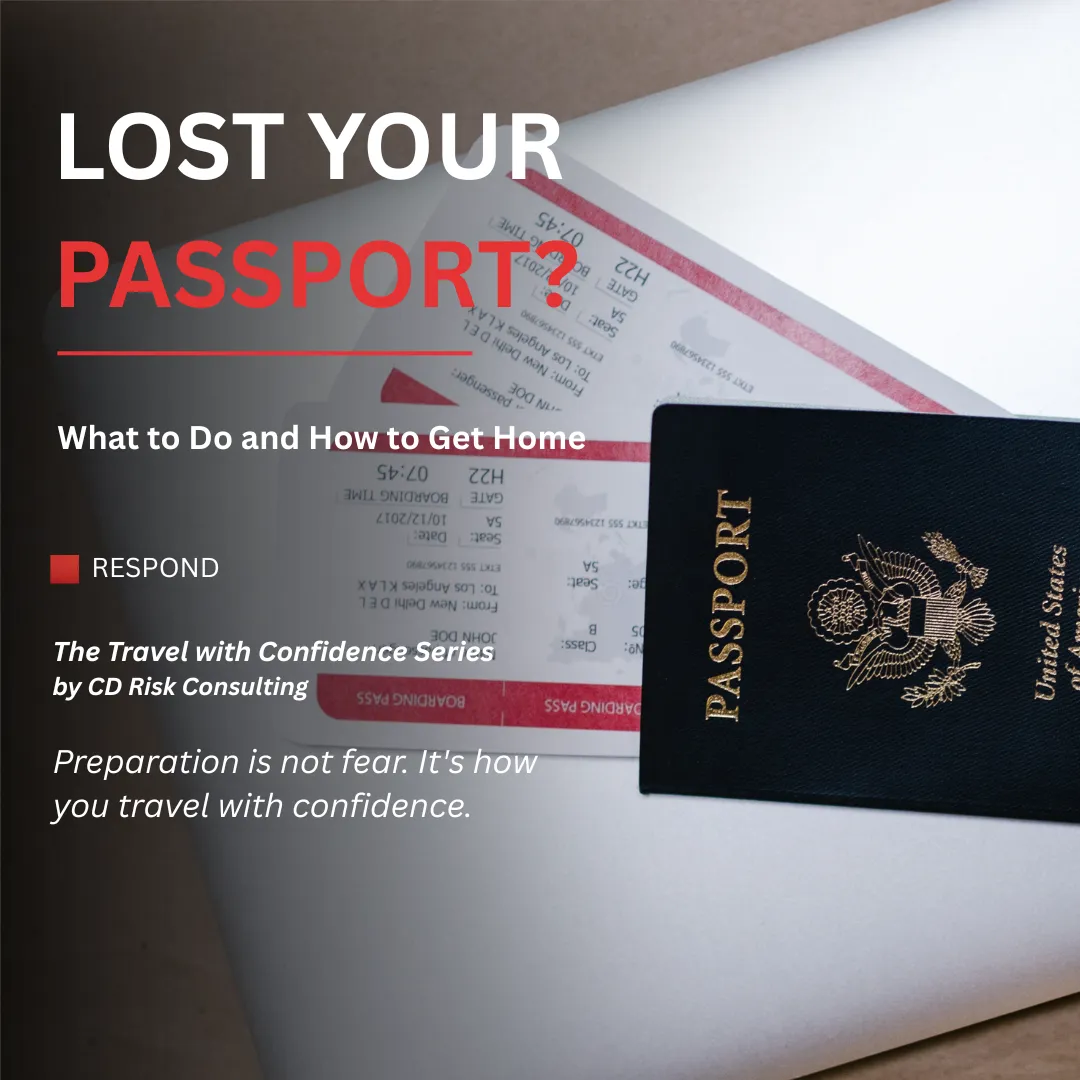
Lost Your Passport Abroad? What to Do and How to Get Home
Imagine you're enjoying an international trip.
You've spent the day exploring a new city, visiting attractions, or simply enjoying some time away.
Then you reach for your passport.
It's not where you expected it to be.
You check your bag. Your pockets. Maybe your hotel room.
Nothing.
For many travelers, especially those traveling alone, discovering that a passport is missing can create immediate uncertainty.
How will you get home? Who should you contact? What happens to your flight?
Here's what I want you to understand:
Losing your passport abroad is a serious inconvenience, but it doesn't mean you're out of options.
There is an established process for replacing a lost or stolen U.S. passport while overseas.
Knowing that process before you need it can help you make better decisions, reduce unnecessary stress, and regain control of your travel plans.
And if you're reading this because your passport is missing right now, start with the checklist below.
Preparation is not fear. It's how you travel with confidence.
Lost Your Passport Abroad? Your First Five Actions
If you've discovered that your passport is missing while traveling internationally, use these five steps to begin working toward a solution.
1. Confirm your passport is missing.
Check your belongings, retrace your recent movements, and contact places where you may have left it. If you suspect theft, prioritize your personal safety.
2. Report the loss or theft.
Once you've confirmed your valid U.S. passport is missing, report it promptly through the official U.S. Department of State process. Remember, a reported passport is canceled and cannot be used again, even if recovered.
3. Contact the nearest U.S. embassy or consulate.
Explain what happened, where you're located, and when you're scheduled to travel. Ask about replacement procedures and emergency passport options.
4. Gather your available documents.
Locate identification, passport copies, travel reservations, and other supporting information. Don't delay contacting the embassy if some documents are unavailable.
5. Review your immediate travel arrangements.
Check upcoming flights, accommodations, and transportation. Contact your airline or travel insurance provider if your plans may be affected.
Remember: You don't need to solve everything at once. Focus on the next appropriate action.
Free Emergency Action Checklist — Save It Before You Need It
Need these instructions somewhere you can access quickly?
I've created a free, one-page Lost Passport Emergency Action Checklist that you can save to your phone or print before your next international trip.
It includes the five immediate actions, official government resources, emergency assistance numbers, and space to record important information.
DOWNLOAD THE FREE EMERGENCY ACTION CHECKLIST — PDF
No signup. No email required. Just practical information when you need it.
Start by Assessing the Situation
When something important goes missing, it's easy to start thinking about everything that could go wrong.
But your first priority should be understanding what actually happened.
Before assuming your passport has been stolen, take a few minutes to check the places where you may have left it.
Think about when you last used it.
Was it at the airport?
During hotel check-in?
At a transportation counter?
Did you place it in a different compartment of your bag?
Retrace your recent movements and contact locations where you may have left it.
If you're staying at a hotel, ask the front desk whether the passport has been turned in.
If you suspect theft, prioritize your personal safety. Don't confront someone or put yourself at risk trying to recover the document.
The objective is to establish the facts and move toward a solution.
Once you've determined that your passport is missing, begin the official reporting and replacement process promptly.
Step 1: Report Your Passport Lost or Stolen
For U.S. passport holders, the Department of State advises reporting a valid lost or stolen passport immediately.
This helps protect your identity and prevents the missing passport from being used for international travel.
You can report your passport through the Department of State's online reporting process, by mail, or in person when applying for a replacement.
The online process is the fastest reporting option.
But there's an important detail travelers need to understand:
Once you report a U.S. passport lost or stolen, it is canceled.
Even if someone finds it and returns it to you later, you cannot use that passport for international travel.
Reporting the loss also does not automatically provide a replacement. You must apply for a new passport.
Official resource: Report Your Passport Lost or Stolen
Should You Contact Local Police?
A police report is not generally required by the U.S. Department of State to replace a passport abroad.
However, reporting the incident to local authorities may be helpful, particularly when theft is suspected.
A police report may help document the circumstances and may be useful for certain insurance claims or other administrative purposes.
If you decide to file a report, request a copy or record the report number.
Remember that local procedures differ by country.
If you're unsure what to do, ask your embassy or consulate for guidance.
Step 2: Contact the Nearest U.S. Embassy or Consulate
If you're a U.S. citizen who loses your passport overseas, the nearest U.S. embassy or consulate is your primary resource for obtaining a replacement.
This is one of the reasons I encourage travelers to identify their embassy or consulate before leaving home.
Don't wait until something goes wrong to figure out where it is.
Visit the official U.S. Embassy and Consulate Directory to locate the appropriate office.
Explain that your passport has been lost or stolen.
Be prepared to provide:
Your name and contact information
Your current location
When and where the passport went missing
Whether you believe it was lost or stolen
Your scheduled departure date
Any immediate travel or safety concerns
If your return flight is approaching, tell consular staff.
They can explain the available appointment procedures and replacement options.
Don't assume you can simply arrive at an embassy and receive a new passport immediately.
Follow the instructions provided by the specific consular office.
What If It's a Weekend or Holiday?
Most U.S. embassies and consulates cannot issue replacement passports during weekends or holidays.
However, they have after-hours duty officers who can assist U.S. citizens experiencing serious emergencies.
If your situation involves urgent travel, a serious crime, or another emergency, contact the embassy or consulate and explain the circumstances.
For emergency assistance, the U.S. Department of State lists these numbers:
From the United States or Canada: 1-888-407-4747
From overseas: +1-202-501-4444
These are important resources to save before an international trip.
Step 3: Gather What You Need for a Replacement Passport
The replacement process is easier when you have access to identification and supporting information.
According to the U.S. Department of State, travelers applying for a replacement passport abroad should be prepared to provide:
A passport photograph meeting U.S. passport requirements
Identification, such as a driver's license or expired passport
Evidence of U.S. citizenship, such as a birth certificate or photocopy of the missing passport
A travel itinerary
Form DS-11, the passport application
Information about where and when the passport was lost or stolen
Applicable passport fees
If you filed a police report, bring a copy.
You'll generally need to appear in person at the embassy or consulate to apply for the replacement.
The consular office will provide instructions based on your circumstances.
What If You Don't Have All Those Documents?
This is where travelers sometimes become unnecessarily discouraged.
Maybe your identification was stolen along with your passport.
Maybe you don't have a copy of your birth certificate.
Or perhaps all your important information was stored on a phone you can no longer access.
Those situations can complicate the process, but they don't automatically prevent you from receiving assistance.
Consular staff can work with travelers who cannot present every requested document. Additional verification may be necessary.
For example, if you cannot provide evidence of U.S. citizenship, consular staff may be able to explain options for verifying your passport records.
The important thing is to communicate your circumstances accurately and follow the instructions provided.
Don't avoid contacting the embassy because you think you're missing too much paperwork.
Step 4: Understand Emergency Passport Options
One of the first questions travelers ask is:
Will I be able to get home?
In many cases, the answer is yes, once the necessary replacement travel document has been issued.
If you have urgent travel plans and there isn't enough time to obtain a regular passport, a U.S. embassy or consulate may issue a limited-validity emergency passport.
These passports may be valid for up to one year.
They are intended to help eligible travelers address urgent international travel needs.
However, there are important limitations.
Not every country accepts emergency passports for entry or transit.
If your return journey includes a connection through another country, verify whether your replacement passport will be accepted.
Don't assume that because a document allows you to return to the United States, it will automatically satisfy every other country's entry requirements.
Also remember that emergency passports are not guaranteed to be issued immediately. Processing depends on the circumstances and the consular office.
After returning home, review the Department of State's instructions for replacing a limited-validity passport with a full-validity document.
Mike's Travel Tip: If you receive an emergency passport, verify your entire return itinerary before leaving the embassy or consulate. A connecting country may have different document requirements.
Step 5: Review Your Travel Plans
Once you've contacted the embassy or consulate, it's time to look at the rest of your trip.
A missing passport can affect more than your ability to board an international flight.
It may also affect transportation, hotel arrangements, scheduled activities, and other reservations.
Start by identifying your most time-sensitive commitments.
Your return flight: Contact the airline if your departure may be affected. Explain that you're arranging a replacement passport and ask about your options.
Connecting flights: Confirm that any replacement travel document will be accepted along your complete route.
Your accommodations: If you need to remain in the destination longer, speak with your hotel about extending your stay or finding another suitable accommodation.
Travel insurance: Contact your insurer or assistance provider to determine whether any benefits or services apply. Coverage varies, so don't assume replacement costs or additional hotel expenses are automatically covered.
Your emergency contact: Let a trusted person know what happened, where you are, and how you can be reached.
The goal isn't to solve every problem simultaneously.
Identify what needs immediate attention, handle those priorities, and work through the remaining issues.
What If Your Passport and Wallet Were Both Stolen?
Losing your passport is challenging enough.
Losing your identification, bank cards, and access to money at the same time adds another layer of complexity.
If this happens, focus on protecting your accounts and maintaining access to essential resources.
Contact your financial institutions through verified channels to report stolen cards and discuss replacement or emergency cash options.
If your phone was also stolen, secure important accounts from another trusted device when possible.
Notify the embassy or consulate if you have limited access to money or identification.
The Department of State provides information about emergency financial assistance for U.S. citizens abroad, although assistance is subject to eligibility and may involve repayment obligations.
Consular staff can explain available options, but you should not assume the embassy will pay your travel or living expenses.
You may also need to contact your travel insurance provider or a trusted person at home.
This is why I recommend having more than one way to access important information and emergency funds while traveling.
Your phone and wallet are convenient.
They should not be your entire backup plan.
Before You Travel: Five Ways to Make Passport Recovery Easier
You cannot guarantee that a passport will never be lost or stolen.
But you can reduce the disruption by preparing before departure.
1. Keep a Secure Copy of Your Passport
Maintain a secure copy of your passport's identification page.
Consider an encrypted digital copy and a paper copy stored separately from the original.
A copy is not a replacement travel document, but it can help consular staff identify your passport information during the replacement process.
2. Identify Your Embassy or Consulate
Before departure, locate the nearest appropriate U.S. embassy or consulate.
Save its address, telephone number, website, and emergency contact instructions.
For travelers from other countries, identify the appropriate embassy or consulate for your nationality.
3. Maintain Backup Access to Important Information
Keep essential contact details available even if your phone is lost or unavailable.
This might include hotel information, emergency contacts, insurance assistance numbers, and reservation details.
Consider keeping a paper copy in a separate location from your primary travel documents.
4. Consider Enrolling in STEP
The U.S. Department of State offers the free Smart Traveler Enrollment Program (STEP).
It allows U.S. citizens and nationals traveling or living abroad to receive information from U.S. embassies and consulates.
Learn more at STEP.
STEP does not replace contacting consular staff when you need assistance, but it can be another useful part of your travel preparation.
5. Have a Financial Backup Plan
Consider how you would pay for transportation, lodging, or replacement expenses if your primary wallet became unavailable.
Depending on your circumstances, that might mean a backup payment card stored separately, an emergency cash reserve, or access to assistance from a trusted person.
The objective is not to carry large amounts of cash.
It's to avoid relying on a single method of payment.
Mike's Travel Tip: Focus on Your Next Decision
Throughout my work in security, travel risk management, and emergency response, one principle has remained consistent:
When something goes wrong, focus on the next appropriate action.
A missing passport can feel overwhelming because travelers immediately begin thinking about the flight home, the cost of replacing documents, and everything that may need to change.
But you don't have to solve the entire situation in the first five minutes.
Start by confirming what happened.
Secure your immediate surroundings and belongings.
Contact the appropriate authorities.
Get accurate information from the embassy or consulate.
Then adjust your travel plans based on the options available.
That sequence helps turn an unexpected problem into a manageable response process.
You may still experience delays, additional expenses, or changes to your itinerary.
But you will be making informed decisions rather than reacting without a plan.
Your Passport Is Missing. Your Options Aren't.
International travel comes with responsibilities.
One of those responsibilities is understanding how to respond when important documents become unavailable.
Losing your passport abroad can be inconvenient, expensive, and disruptive.
But U.S. travelers have an established process for reporting the loss and requesting replacement documents through an embassy or consulate.
The key is knowing where to begin.
Confirm the loss.
Report it promptly.
Contact your embassy or consulate.
Follow the replacement process.
Adjust your travel plans as needed.
And before your next trip, take a few minutes to organize the information and resources that could make an unexpected situation easier to manage.
For additional preparation guidance, explore these Travel with Confidence Guides:
You can also download my Free Pre-Travel Checklist to review your documents, emergency contacts, destination research, and other important travel preparations before departure.
Because traveling confidently doesn't mean nothing will ever go wrong.
It means understanding what you can do when something does.
Preparation is not fear.
It's how you travel with confidence.
Last reviewed: October 18, 2026.
This Guide focuses on U.S. passport holders. Procedures for other nationalities vary. Passport requirements, fees, and consular services can change. Always verify current instructions through the appropriate embassy, consulate, or official government website.

