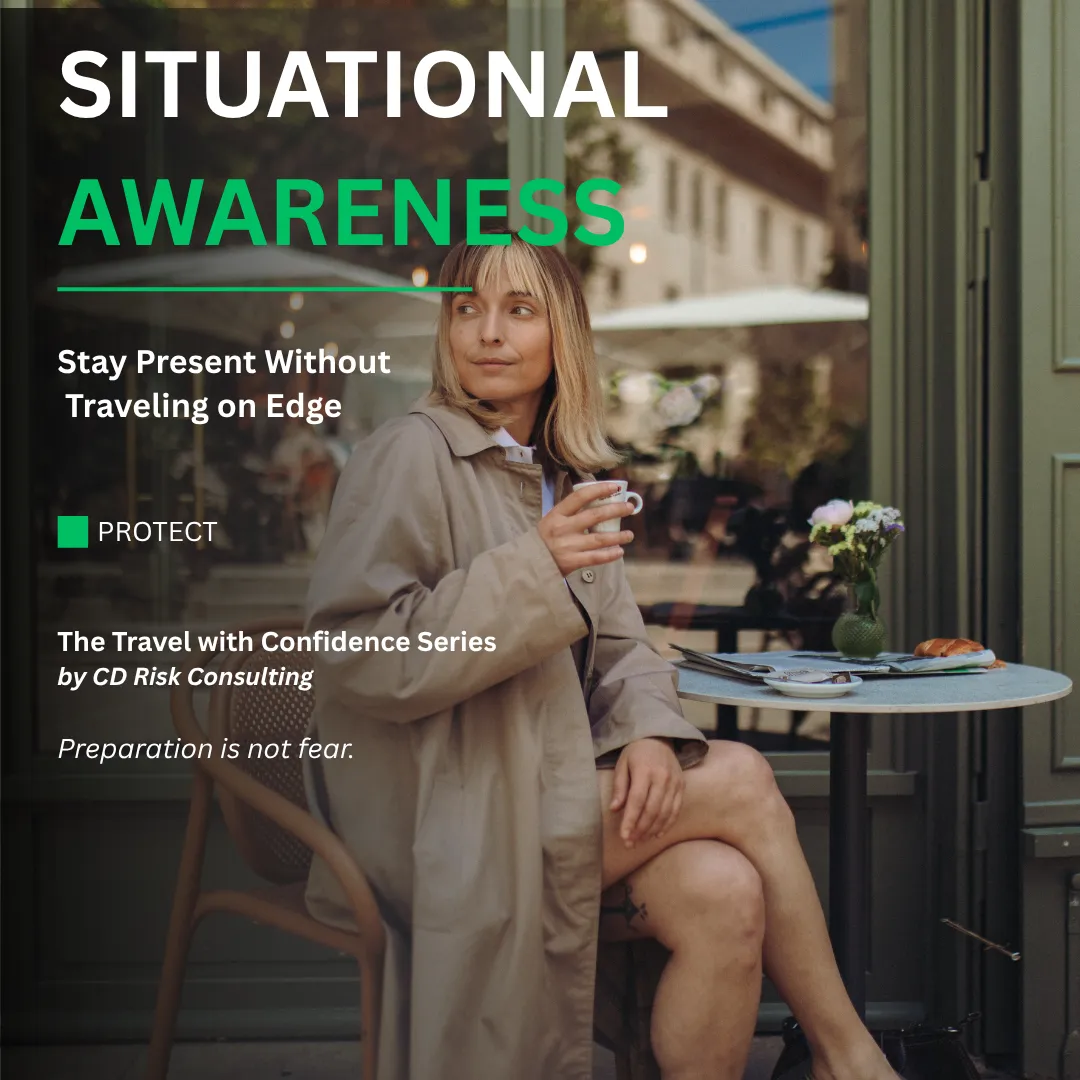
Situational Awareness: How to Stay Present Without Traveling on Edge
Travel should be something you experience—not something you spend constantly worrying about.
You should be able to walk through a new city, enjoy dinner, explore a market, sit by the pool, or navigate an airport without feeling like you need to watch every person around you.
But there is a difference between being relaxed and being unaware.
That difference is situational awareness.
After working in security for more than 25 years, I've learned that situational awareness isn't about expecting something bad to happen. It's about understanding your environment well enough to recognize when something changes—and knowing what options you have if you need them.
You don't need a security background to develop that skill.
You simply need to learn how to be present.
Preparation is not fear.
It is how you travel with confidence.
What Is Situational Awareness?
At its simplest, situational awareness means understanding:
Where you are.
What's happening around you.
What doesn't seem to fit.
And what options you have if something changes.
Think about walking into a restaurant.
Without consciously thinking about it, you may notice where the host stand is, where people are sitting, whether the restaurant is crowded, and where the restroom is located.
Situational awareness takes that natural observation one step further.
Where are the exits?
Where are employees?
What does normal activity look like here?
Is there anything happening that deserves more of your attention?
You're not searching for danger.
You're establishing a baseline.
And once you understand the baseline, changes become easier to recognize.
Start With the Baseline
One of the most useful concepts I teach is understanding what normal looks like in the environment you're in.
Every environment has a baseline.
At an airport, people are moving toward gates, looking at departure boards, carrying luggage, standing in lines, and checking phones.
At a resort pool, people are relaxing, talking, swimming, ordering drinks, and moving between chairs and the hotel.
At a train station, people are watching schedules, buying tickets, waiting on platforms, and moving toward trains.
You don't need to analyze every person.
You're simply developing a general understanding of the environment.
Once you have that baseline, you can recognize when something changes.
Maybe a crowd suddenly starts moving in one direction.
Maybe someone who appeared to be waiting for a train begins following your movements instead.
Maybe an argument nearby starts escalating.
Maybe an exit that was previously open becomes blocked.
Maybe the atmosphere around you simply changes.
Awareness gives you time.
And time gives you options.
Cooper's Color Code: A Simple Awareness Model
One framework I use when teaching situational awareness is Cooper's Color Code, a system developed by Lieutenant Colonel Jeff Cooper to describe different states of awareness.
It was originally developed in a different context, but the basic concept can be adapted into a useful awareness model for everyday travelers.
Think about awareness in four levels.
White — Unaware
You're disconnected from what's happening around you.
Maybe you're walking through an unfamiliar area while completely focused on your phone.
Maybe you're wearing noise-canceling headphones and aren't noticing what's happening nearby.
Maybe you're so focused on your luggage that you haven't looked around in several minutes.
There are times when being completely relaxed is appropriate.
But in public and unfamiliar environments, we don't want to remain in White.
Yellow — Relaxed Awareness
This is where I want travelers most of the time.
You're relaxed.
You're enjoying yourself.
You're not suspicious of everyone around you.
But you're generally aware of your environment.
You notice who's nearby.
You occasionally look up from your phone.
You know roughly where you're going.
You notice exits when entering unfamiliar spaces.
You recognize significant changes around you.
Yellow isn't anxiety.
It's presence.
Orange — Something Has Your Attention
Something has changed.
Maybe someone seems unusually interested in you.
Maybe an argument is escalating.
Maybe you've noticed someone following the same movements you've made several times.
Maybe you smell smoke.
Maybe transportation suddenly stops operating.
Maybe something simply doesn't fit the baseline you established.
You haven't necessarily identified a threat.
But something deserves more attention.
This is when you reduce distractions and begin thinking about your options.
Where can I move?
Where is the nearest exit?
Where are employees or security personnel?
Who can I contact?
Do I need to change what I'm doing?
Red — It's Time to Act
You've identified a situation requiring action.
That doesn't automatically mean confrontation.
For a traveler, action might mean:
Leaving the area.
Entering a staffed business.
Calling emergency services.
Moving toward security personnel.
Changing transportation.
Returning to your hotel.
Alerting someone you're traveling with.
Following evacuation instructions.
The important point is that you've already been thinking about your options.
You're not starting from zero.
Situational Awareness Doesn't Mean Watching Everyone
This distinction matters.
Situational awareness is not profiling people based on appearance, nationality, race, clothing, age, or whether someone simply seems different from you.
You're observing behavior and circumstances.
Instead of:
“That person looks suspicious.”
Ask:
“What behavior am I actually noticing?”
Are they repeatedly changing direction when you do?
Are they violating normal boundaries?
Are they trying to distract you while someone else approaches?
Are they becoming increasingly aggressive?
Are they blocking your movement?
Are they attempting to isolate you?
Behavior gives you something objective to evaluate.
Appearance usually doesn't.
Reduce Distractions Without Giving Up Your Phone
Your phone is one of the most useful travel tools you have.
I use mine constantly while traveling.
Maps.
Transportation.
Translation.
Hotel information.
Boarding passes.
Emergency contacts.
Weather.
Travel advisories.
The answer isn't to stop using your phone.
It's to avoid becoming consumed by it.
If you're using Google Maps while walking, periodically look up and reconnect with your surroundings.
Instead of staring at the map for several blocks, review your route, identify a landmark or turn, walk toward it, and check again when necessary.
If you need several minutes to figure something out, step into a café, hotel lobby, store, or another appropriate location rather than standing distracted on a sidewalk.
Technology should improve your awareness.
It shouldn't replace it.
Know Your Options Before You Need Them
Whenever I enter an unfamiliar environment, one of the things I'm naturally thinking about is:
What are my options?
You can develop the same habit.
When you enter a hotel, notice the exits.
When you sit in a restaurant, understand how you entered and whether another exit exists.
When you're using public transportation, know where you're getting off.
When you're walking through an unfamiliar neighborhood, know where you're headed rather than simply following your phone.
When you arrive at your hotel room, review the evacuation route.
This connects directly with the routine I discuss in Before You Unpack: A Hotel Room Safety Routine Every Traveler Should Know.
You don't need to create an elaborate escape plan everywhere you go.
You're simply avoiding a situation where your first thought during a problem is:
“Now what?”
Trust Your Instincts—Then Give Yourself Permission to Act
Travelers sometimes notice something uncomfortable and then immediately try to explain it away.
Maybe you're overreacting.
Maybe you misunderstood.
Maybe you don't want to appear rude.
Maybe you don't want to inconvenience anyone.
Here's the important distinction:
You don't need certainty before making a low-risk safety decision.
You can change seats.
You can cross the street.
You can leave the bar.
You can cancel the ride.
You can return to your hotel.
You can ask hotel staff for assistance.
You can move toward other people.
You can say no.
You can change your plans.
If you later discover there was no danger, you've lost very little.
Situational awareness isn't about proving that your concern was correct.
It's about recognizing when something deserves your attention and giving yourself permission to respond appropriately.
Awareness Changes With the Environment
Your awareness level shouldn't be identical everywhere.
Walking through a busy transportation hub at midnight requires a different level of attention than sitting by the pool at your resort.
Consider factors such as:
Time of day
An environment can change significantly after dark.
Crowds
Crowded spaces can create distraction, separation, and opportunities for theft. Crowds deserve additional planning when you're attending concerts, sporting events, festivals, or other large gatherings. See Major Event Travel Safety for a deeper look at navigating those environments.
Alcohol
Alcohol can affect judgment, coordination, and awareness.
Transportation
Airports, train stations, rideshares, taxis, and public transportation each create different considerations.
Familiarity
You're naturally going to need more attention in an unfamiliar environment.
Fatigue
Travel days can be exhausting. Fatigue can reduce your ability to notice details and make good decisions.
Your awareness should adjust with the environment.
That's part of being intentional rather than fearful.
Situational Awareness Starts Before the Trip
Some of the best situational awareness happens before you ever arrive.
Destination research gives you a baseline before stepping off the plane.
You can learn:
How transportation normally works.
What common scams travelers encounter.
Which neighborhoods require additional consideration.
Local customs and expectations.
Where your hotel is located.
What major events are occurring during your stay.
Whether demonstrations, strikes, severe weather, or other disruptions could affect your plans.
How to contact local emergency services.
That's why Know Your Destination: Why Destination Awareness Is Part of Every Travel Safety Plan is such an important part of the planning process.
Research gives context to what you observe once you're there.
Practice Awareness in Everyday Life
You don't need to wait until vacation to develop situational awareness.
Practice at home.
The next time you enter a restaurant, casually identify another exit.
When you're walking through a parking garage, put your phone away and observe the environment.
When you enter a store, notice where employees are located.
When you're sitting somewhere public, occasionally look around rather than remaining focused entirely on your screen.
When something catches your attention, ask yourself:
What specifically did I notice?
The more you practice, the less deliberate the process becomes.
Eventually, awareness becomes a habit.
And that's exactly what we want.
Awareness Is Part of Your Travel Safety Plan
Situational awareness shouldn't exist by itself.
It's one layer of a larger travel safety system.
Your destination research helps you understand the environment.
Your personal safety plan gives you options, including backup plans when transportation, communication, or other parts of your trip change. Solo Travel Success: Build a Plan Without Losing the Adventure explores how to build those options without overplanning your trip.
Your travel checklist helps you prepare.
Your communication plan keeps trusted people informed.
Your situational awareness helps you recognize when something has changed.
And your response plan helps you decide what to do next.
That's why I don't teach travelers to rely on one gadget, one app, or one safety tip.
Safety works best in layers.
You can learn more about building those layers in Travel Smart, Not Scared: How to Build a Personal Travel Safety Plan and 5 Travel Safety Habits Every Woman Should Build.
Travel Aware, Not Afraid
The goal of situational awareness isn't to spend your vacation looking over your shoulder.
Quite the opposite.
When you understand your environment, recognize meaningful changes, and know what options are available, you can spend less time wondering what you'd do if something happened.
Enjoy the restaurant.
Explore the market.
Walk through the museum.
Sit on the beach.
Meet people.
Try something new.
Just remain connected to what's happening around you.
Be relaxed.
Be present.
Know your options.
That's situational awareness.
And it's one of the most valuable travel habits you can develop.
For more tools to help prepare for your next trip, download the Free Pre-Travel Checklist and start building a travel routine that works wherever your next adventure takes you.
Preparation is not fear.
It is how you travel with confidence.

