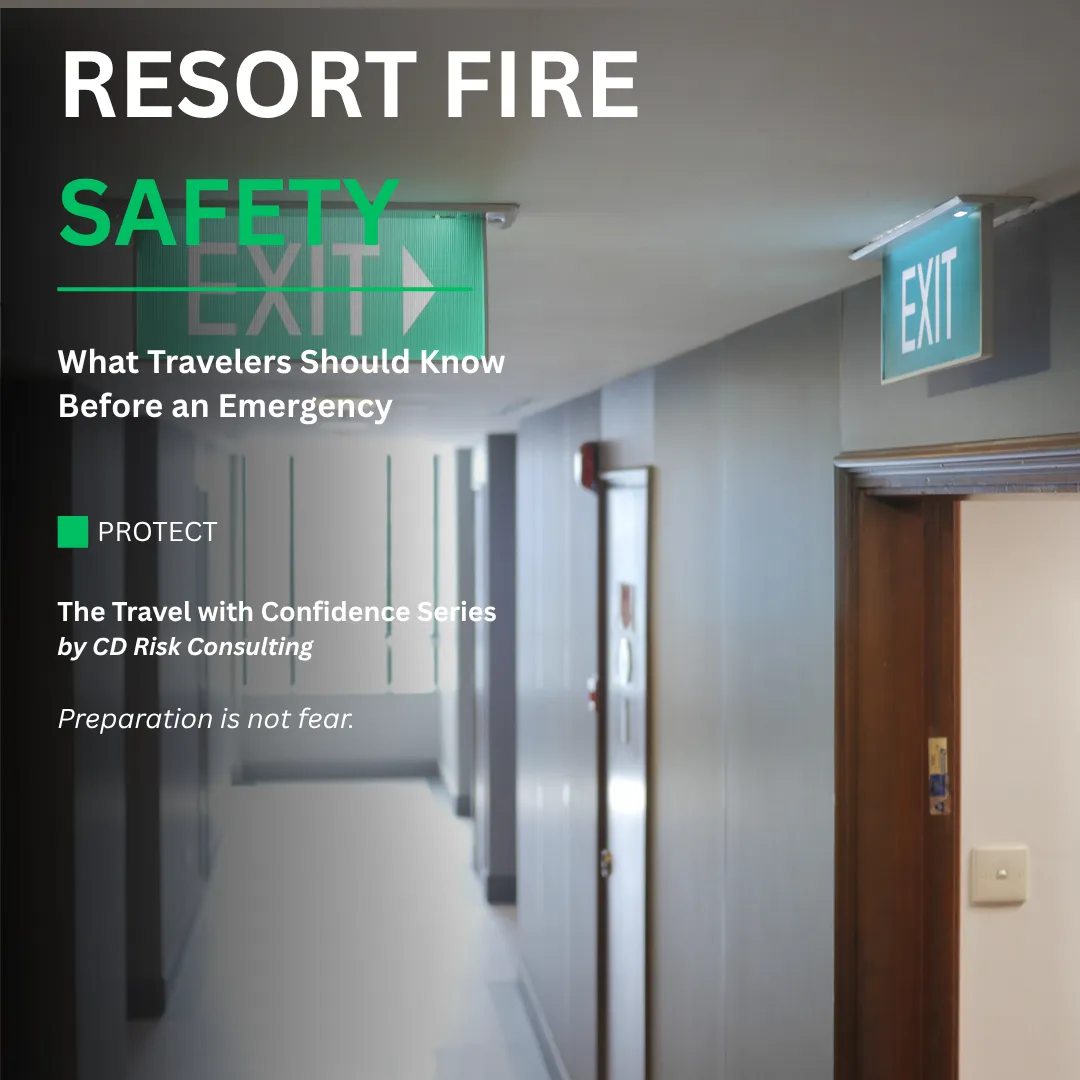
Resort Fire Safety: What Travelers Should Know Before an Emergency
A resort is designed to help you relax.
You check in, drop your bags, look around the room, find the pool, make dinner plans, and start thinking about everything you want to do during your trip.
That's exactly what vacation should feel like.
But relaxing doesn't mean completely switching off your awareness.
A major resort fire in the Dominican Republic was the reason I originally started thinking about this Guide. It was another reminder that emergencies don't stop because we're on vacation.
Fire. Smoke. Power outages. Medical emergencies. Severe weather. Evacuations.
They can happen anywhere.
That doesn't mean you should arrive at every resort expecting something to go wrong.
It means taking a few minutes to understand what you would do if something did.
You don't need to memorize the entire property.
You need to know your first move.
Preparation is not fear.
It's how you travel with confidence.
Your Fire Safety Plan Starts When You Arrive
The first few minutes after arriving at a hotel or resort matter.
Most travelers check the room, put down their bags, connect to Wi-Fi, and start settling in.
Before you completely relax, add one more step.
Look at how you would get out.
The U.S. Fire Administration recommends reviewing the property's evacuation plan, locating the two closest exits from your room, and counting the number of doors between your room and those exits.
That doesn't take long.
And you're not inspecting the building like a firefighter.
You're simply answering:
If I needed to leave this room quickly, where would I go?
If you already use my Before You Unpack: A Hotel Room Safety Routine Every Traveler Should Know Guide, this should become part of that arrival routine.
Fire isn’t the only hotel hazard worth preparing for. Carbon monoxide can be especially difficult to recognize because it is colorless and odorless. Learn more in Carbon Monoxide Safety: What Every Traveler Should Know.
Know Two Ways Out
Don't rely only on the route you used to reach your room.
Find the nearest exit.
Then find another one.
Depending on the property, that might mean another stairwell, outdoor walkway, exterior exit, or another marked evacuation route.
Why two?
Because your normal route may not be available during an emergency.
Smoke, fire, crowds, or other conditions could block it.
USFA specifically recommends identifying the two closest exits from your hotel room.
Your first option matters.
Your second option matters too.
Count the Doors
This is one of the simplest hotel fire-safety habits I teach.
If your room is inside a hotel-style building, count the number of doors between your room and the nearest exit.
Then do the same for your alternate exit if practical.
Why?
Because smoke can dramatically reduce visibility.
You may not be able to rely on signs, landmarks, or what you remember seeing when you walked down the hallway.
Knowing approximately how many doors you need to pass gives you another way to orient yourself.
This isn't just one of my security habits. It's also part of USFA's hotel fire-safety guidance.
It's simple.
It takes less than a minute.
And once you've done it, you can go enjoy your trip.
Read the Evacuation Map
Most hotel rooms have an evacuation diagram posted on or near the door.
Don't let it become part of the wallpaper.
Take a moment to look at it.
Find:
Your room
Primary exit
Alternate exit
Stairwells
Fire alarms
Assembly areas, if identified
Then connect that map to what you actually saw in the hallway.
If you're staying at a sprawling resort with separate buildings, villas, restaurants, pools, or entertainment areas, the evacuation route may look different from a traditional hotel.
Adapt your plan to the property.
The principle stays the same:
Know where you are. Know where you're going. Know another way out.
Your Go Bag Has a Role Here
When I teach travel preparation, I recommend creating a small Go Bag containing important items you may need if you have to move quickly.
The purpose isn't to pack another suitcase.
It's to avoid searching through your luggage when time matters.
Depending on your trip and personal needs, your Go Bag might contain items such as:
Identification
Essential medication
Backup payment method
Emergency contact information
Portable charger
Important travel information
Small flashlight
Other essential items specific to you
Keep it somewhere accessible.
But there is an important rule:
Getting to safety comes first.
If an alarm sounds or you need to evacuate, do not delay leaving to search for belongings.
If your Go Bag is immediately accessible and can be taken without delaying your evacuation, take it.
If it isn't, leave it.
And never return to an unsafe building to retrieve it. Red Cross fire guidance emphasizes getting out, staying out, and leaving belongings behind rather than delaying escape.
This is exactly why we prepare the bag before the emergency.
The preparation happens when you have time.
The evacuation happens when you don't.
What If the Fire Alarm Sounds?
Take it seriously.
Don't immediately assume:
"It's probably a false alarm."
If an alarm sounds, you smell smoke, see smoke, or notice people evacuating, shift from relaxation mode to assessment mode.
If conditions allow you to evacuate safely, leave promptly using the stairs and your identified exit route.
Don't use an elevator during a fire evacuation unless emergency personnel specifically direct you to do so. Red Cross guidance directs occupants to use stairs rather than elevators during a building fire.
And don't spend valuable time collecting belongings.
Remember:
You already know your first move.
Check Before Opening the Door
If there may be fire or smoke outside your room, don't automatically open the door.
Check the door and handle for heat before opening it.
If the door or handle is warm, or smoke is blocking your primary route, use your alternate escape route rather than opening the door into potentially dangerous conditions.
This is another reason knowing two ways out matters.
Your normal route isn't necessarily your emergency route.
If You Encounter Smoke, Stay Low
Smoke can make an otherwise familiar hallway difficult to navigate.
If you must move through smoke while evacuating, stay low where the air may be clearer and continue toward your exit. Red Cross fire guidance specifically advises getting low and moving beneath smoke when escaping.
This is also where counting doors can become useful.
You may not be able to see the stairwell from where you are.
But you have already given yourself another reference point.
That's preparation doing its job.
What If You Can't Safely Leave?
This is something travelers don't always consider.
There may be situations where smoke, heat, or fire prevents you from safely reaching an exit.
If your escape routes are blocked, don't force yourself into dangerous conditions simply because you believe you have to get into the hallway.
Red Cross guidance advises remaining in the room with the door closed when smoke, heat, or flames block escape routes, contacting emergency services, and signaling your location from a window when possible.
If you're trapped:
Keep the door closed.
Call the local emergency number and report your location.
Follow emergency instructions.
Signal your location from a window if appropriate.
Stay low if smoke begins entering the room.
This is also why knowing your room number and location within the property matters.
During an emergency, responders need to know where you are.
Once You're Out, Stay Out
Once you've evacuated, move to the designated assembly area or another safe location away from the building.
Follow instructions from hotel staff and emergency personnel.
And don't go back inside because you forgot your passport, phone, luggage, medication, or Go Bag.
Those things matter.
Your safety matters more.
Red Cross guidance is very clear on this point: get out and stay out.
This is another reason preparation matters.
Important documents can be backed up.
Medication information can be documented.
Family members can have copies of your itinerary.
Insurance can help with losses.
Your travel plan should give you options after the emergency so you aren't tempted to create another emergency trying to recover belongings.
Have a Communication Plan
Before traveling, someone you trust should know where you're staying.
Consider sharing:
Resort or hotel name
Address
Travel dates
General itinerary
Emergency contact information
Travel insurance details
If you're traveling with other people, also discuss where you would reconnect if everyone became separated during an evacuation.
The Red Cross recommends having emergency contacts available both digitally and in writing and establishing communication plans for emergencies.
If you're traveling solo, your communication plan becomes even more important.
My Solo Travel Success: Build a Plan Without Losing the Adventure Guide goes deeper into creating that system before your trip.
Mike's Travel Tip
When you arrive at your room, don't just look at the evacuation map.
Walk to the exit.
Then count the doors on your way back.
A map tells you where the exit should be.
Walking the route helps you understand what the environment actually looks like.
Notice:
Where the stairwell is.
Which direction the hallway turns.
How many doors you pass.
Where your alternate exit is.
You aren't expecting a fire.
You're removing uncertainty before an emergency.
Then go enjoy your trip.
Think Beyond Your Room
Fire safety doesn't stop at your hotel-room door.
Large resorts may include restaurants, theaters, conference rooms, spas, clubs, pools, casinos, and other spaces where you're unfamiliar with the layout.
You don't need to conduct a security assessment every time you enter a restaurant.
But maintain basic awareness.
Where did you enter?
Where is another exit?
Where are the crowds?
Where would you move if something changed?
That's situational awareness.
The same principle applies whether you're walking through an unfamiliar city, attending a major event, sitting in a restaurant, or relaxing at a resort.
Know your environment without allowing your environment to consume your attention.
Preparation Protects the Experience
Most travelers will never experience a hotel or resort fire.
That's a good thing.
The purpose of preparing isn't to convince yourself that an emergency is likely.
It's to make a few important decisions while everything is calm.
Find two exits.
Count the doors.
Review the evacuation map.
Keep your Go Bag accessible.
Know what you'll do if you encounter smoke.
Have a communication plan.
Then stop thinking about it.
Go to the beach.
Enjoy dinner.
Explore the destination.
That's what preparation is supposed to give you.
Not more worry. More confidence.
Build Your Travel Safety Plan Before You Leave
Hotel and resort safety begins before check-in.
Research your destination, organize your documents, review emergency contacts, understand your insurance, and decide what information and essential items you want immediately accessible.
My FREE Pre-Travel Checklist can help you build that foundation before your next trip.
And as we continue building the Travel with Confidence library, I'll also be sharing more about how to create a practical Travel Go Bag and the tools I personally use when I travel.
Remember:
The tools support the plan.
They don't replace the plan.
Preparation is not fear.
It's how you travel with confidence.

