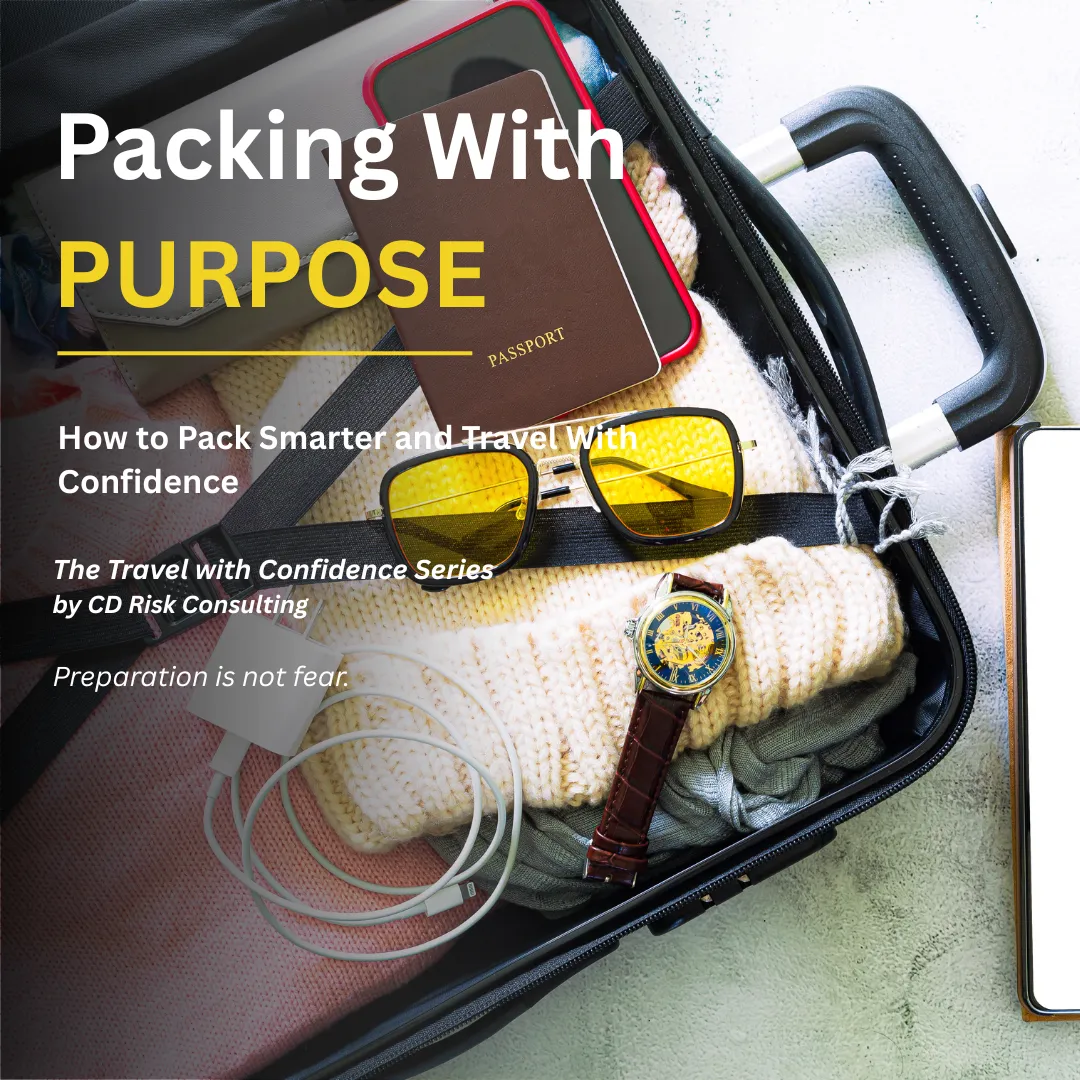
Packing With Purpose: How to Pack Smarter and Travel With Confidence
Packing is one of the last things most people do before leaving for a trip.
Throw a few outfits into a suitcase. Grab a charger. Toss in some toiletries. Zip it up and head to the airport.
But after more than 25 years working in executive protection, travel security, and emergency response, I've learned that the way you pack says a lot about how prepared you'll be when something doesn't go according to plan.
Because travel rarely goes exactly as expected.
Flights are delayed. Luggage gets misplaced. Weather changes. Phones die. Plans shift. Sometimes the unexpected is nothing more than an inconvenience. Other times, it's a situation that requires you to think quickly and adapt.
You can't control every circumstance you'll encounter, but you can control how prepared you are to handle it.
That's what packing with purpose is all about.
It isn't about filling every inch of your suitcase or packing for every worst-case scenario.
It's about bringing the things that help you stay organized, solve problems, and travel with confidence.
As I often say:
Preparation is not fear. It's how you travel with confidence.
Start with Your Plan, Not Your Suitcase
Before you decide what clothes to pack, take a step back and think about the trip itself.
Ask yourself:
Where am I going?
What's the weather expected to be?
How will I be getting around?
Will I have access to pharmacies or grocery stores?
Am I traveling alone or with others?
What would I need if my luggage didn't arrive?
What if my phone battery died?
If I had to leave quickly, would I have everything I needed?
These questions aren't designed to make you worry.
They're designed to help you prepare.
Every answer helps determine what belongs in your bag—and what doesn't.
One of the biggest mistakes travelers make is packing based on habit instead of purpose.
Instead, every item should earn its place.
Ask yourself:
Does this help keep me safe?
Does this help keep me organized?
Will this make it easier to solve a problem if my plans change?
If the answer is no, you probably don't need it.
Pack the Essentials Before the Extras
Most travelers spend more time deciding which shoes to bring than making sure they have everything they'll need if something unexpected happens.
Start with the essentials first.
Travel Documents
Keep your most important documents organized and easy to access.
This includes:
Passport or government-issued ID
Driver's license
Hotel confirmations
Flight information
Travel insurance details
Emergency contacts
Copies of prescriptions
A backup credit card
A small amount of emergency cash
Don't rely only on your phone.
Download digital copies, but also carry printed copies separately from the originals. If your phone is lost, damaged, or out of battery, you'll still have what you need.
Health Essentials
If you take medication every day, it belongs in your carry-on—not your checked luggage.
Your health kit should include:
Prescription medications
Basic first aid supplies
Pain reliever
Motion sickness medication
Electrolyte packets
Hand sanitizer
Any personal medical items you depend on
Hopefully, you won't need most of these items.
But if you do, you'll be glad you planned ahead.
Technology That Keeps You Connected
Your phone has become one of your most valuable travel tools.
It helps you navigate unfamiliar cities, communicate with family, access reservations, translate languages, request transportation, and contact emergency services.
Before you leave, download offline maps, save emergency contacts, and review your Personal Travel Safety Plan.
Protect your ability to use it.
Pack:
Portable power bank
Charging cable
Wall charger
Universal adapter for international travel
Backup earbuds
Offline maps downloaded before you leave
Your hotel's address saved both digitally and on paper
One dead phone shouldn't derail your entire trip.
A Few Small Safety Items Can Make a Big Difference
You don't need to carry a backpack full of security equipment to travel safely.
Sometimes the smallest items provide the greatest peace of mind.
Consider packing:
Portable door lock or doorstop alarm
Personal safety alarm
Small flashlight
Compact first aid kit
Location-sharing app with someone you trust
Depending on where you're staying, you may also decide that a portable carbon monoxide alarm belongs in your travel safety kit. Learn what to consider in Carbon Monoxide Safety: What Every Traveler Should Know.
These tools aren't about expecting something bad to happen.
They're about giving yourself options if something unexpected does.
Throughout my career, I've learned that prepared people don't panic as easily because they've already thought through what they would do.
Preparation builds confidence.
Mike's Travel Tip
One lesson I've learned after decades working in travel security is this:
The most prepared traveler isn't the one carrying the most gear.
It's the person who knows exactly what they packed, where to find it, and how to use it.
Preparation isn't measured by how much you carry.
It's measured by how well you've thought ahead.
Pack Smart, Not Heavy
One of the biggest myths about preparedness is that it requires packing more.
In reality, smarter travelers often pack less.
Choose clothing that can be mixed and matched.
Wear comfortable shoes you've already broken in.
Bring layers instead of bulky clothing.
Leave room in your suitcase for souvenirs or unexpected purchases.
A lighter bag is easier to carry through airports, train stations, hotels, and city streets.
More importantly, it gives you greater flexibility if your plans change.
Every item should have a purpose.
If it doesn't, leave it at home.
Prepare for the First 24 Hours
Checked luggage can be delayed or mishandled, and even a short delay can create unnecessary stress if you've packed everything in your checked suitcase.
That's why I recommend preparing for your first 24 hours without it.
In your carry-on or personal bag, pack:
One change of clothes
Prescription medication
Basic toiletries
Phone charger
Travel documents
Power bank
Any item you can't easily replace
If your luggage arrives late, you'll still be able to continue your trip with minimal disruption.
That's not overplanning.
That's smart planning.
A Simple Packing Checklist
Before you zip your suitcase, make sure you've packed the essentials:
✔ Passport or ID
✔ Travel documents
✔ Emergency contacts
✔ Prescription medications
✔ Portable charger
✔ Charging cables
✔ Travel insurance information
✔ Backup payment method
✔ Small first aid kit
✔ One change of clothes in your carry-on
Take one final look through your bag and ask yourself:
"If something unexpected happened today, do I have what I need to solve the problem?"
If the answer is yes, you're ready.
Travel with Confidence Starts Before You Leave Home
Packing isn't just about what fits inside your suitcase.
It's about preparing yourself for the journey ahead.
When you know where your important documents are, have the essentials within reach, and have thought through the most common travel challenges, you remove uncertainty and replace it with confidence.
You don't need to prepare for every possible problem.
You simply need to prepare well enough that if something unexpected happens, you have options.
That's the difference between reacting to a situation and confidently managing it.
Before your next trip, download my FREE Pre-Travel Checklist to help you organize your documents, pack your essentials, review emergency contacts, and create a simple travel safety plan before you leave home.
Pack smart.
Stay aware.
Travel with confidence.

